

Hello, community! We frequently analyze research from the Metricool team. They often explore current trends related to advertising on TikTok and other social networks. Today, we’re taking a look at their latest study. It should be interesting and extremely useful for both beginners and experienced affiliate media buyers.
Before we begin, here’s a reminder that we recently discussed whether it’s possible to do affiliate marketing without investment. We recommend checking it out!
Key Takeaways
- Metricool analyzed 629,000 Meta and TikTok ad campaigns to determine where traffic is cheaper to buy in 2026.
- Meta ad spending increased by 47%, while ROAS fell from 5.48x to 4.57x, whereas TikTok remained more affordable.
- TikTok has a lower CPM ($0.38) and CPC ($0.03) than Meta ($0.48 and $0.07, respectively).
- The average cost per lead on TikTok ($2.69) is considerably lower than on Meta ($6.00), despite Meta’s higher CTR.
- Neither platform can be called definitively better; it is important to compare data at specific stages of the funnel.
What Did Metricool Study This Time?
Metricool analyzed nearly 629,000 ad campaigns across Meta and TikTok and more than $471 million in ad spend. The main goal was to find out where traffic, leads, and sales are cheaper to acquire in 2026. The study also explores what these numbers could mean for affiliate media buyers.
For the study, Metricool used data from 44,355 advertisers. The periods compared were January–June 2025 and January–June 2026.
Overall, the team uncovered plenty of useful and interesting insights and statistics. Let’s take a closer look.
Meta Became More Expensive but Less Effective
One of the study’s most revealing figures is that the average spend per Meta campaign increased by 47% year over year. In 2025, the average spend per campaign was $489.53, rising to $718.45 in 2026.
For TikTok, the change was much smaller: from $1,262.10 to $1,308.97, or approximately 4%.
However, Meta’s growing budgets did not translate into proportional improvements in performance. Quite the opposite: average ROAS for Meta campaigns fell from 5.48x to 4.57x. In other words, for every $1 spent in 2025, campaigns generated an average of $5.48 in notional profit, compared with $4.57 in 2026.
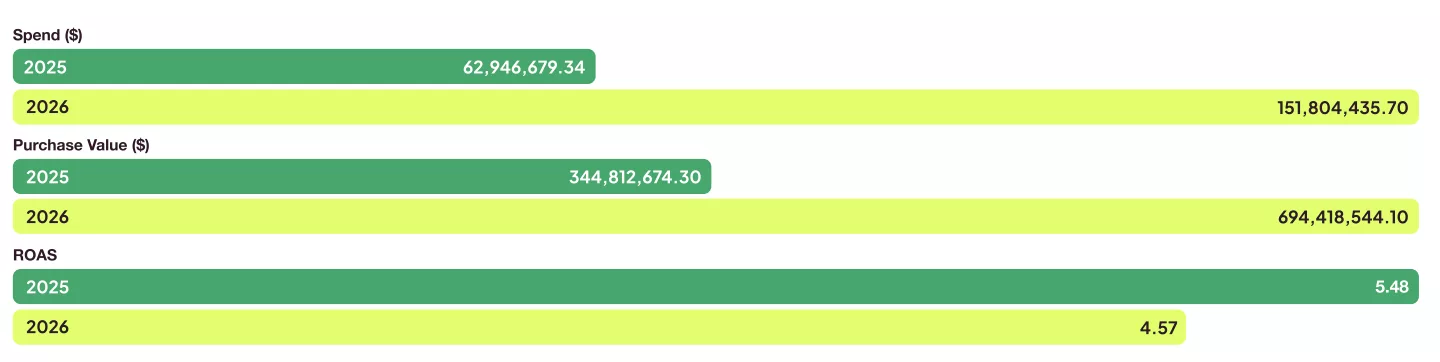
For us as affiliate media buyers, this is a particularly important trend: increasing a budget does not automatically make a traffic source more effective. Metricool also notes that even the largest accounts do not automatically deliver better returns. In the “Largest Advertisers” category, with spending above $10,000 per month, ROAS in 2026 stood at 3.97x.
TikTok Has a Lower CPM Than Meta
Looking at the top of the funnel, TikTok’s advantage becomes clearer. The study reports the following average CPM figures:
| Platform | CPM |
| Meta | $0.48 |
| TikTok | $0.38 |
This means that 1,000 impressions on TikTok cost 22% less on average than on Meta.
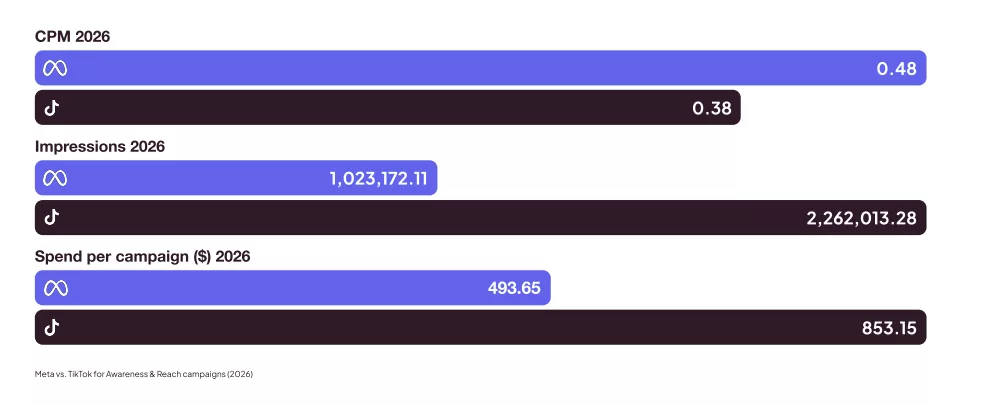
Interestingly, TikTok also receives a higher average campaign budget: $853.15 versus $493.65 for Meta.
As a result, an average TikTok campaign with a substantial budget generated more than 2.2 million impressions, compared with around 1 million on Meta. For verticals where large volumes of low-cost impressions and subsequent audience engagement matter, this is a figure worth paying attention to.
The Biggest Difference Is in Cost per Click
At the traffic acquisition stage, the difference becomes even more noticeable.
Average CPC:
- Meta – $0.07
- TikTok – $0.03
In other words, a click from TikTok cost less than half as much, on average, as a click from Meta.
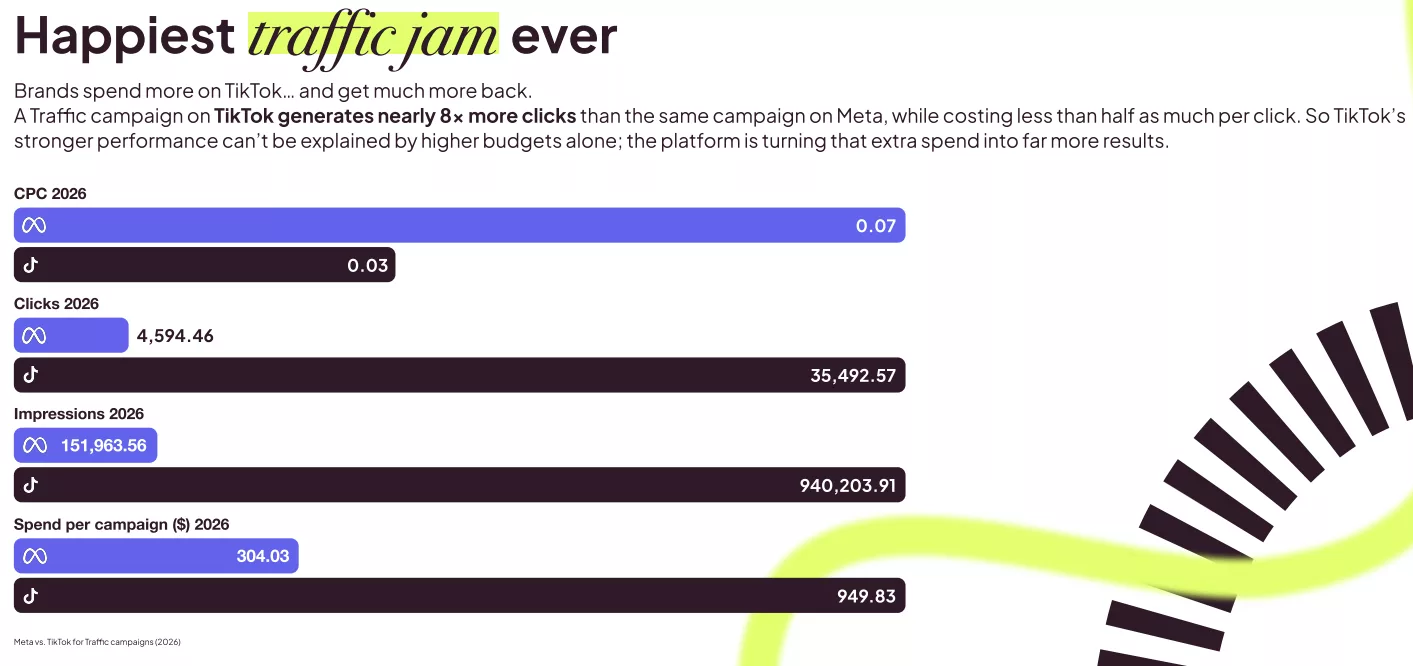
As for reach, the average results of a single Traffic campaign were:
- Meta – approximately 4,594 clicks;
- TikTok – approximately 35,493 clicks.
But there is an important nuance: the average TikTok campaign budget was also significantly higher – $949.83 versus $304.03 on Meta. So comparing click counts alone, without accounting for ad spend, would be misleading.
For affiliate media buyers, the practical takeaway is simple: a low CPC does not automatically mean a low cost per conversion. You need to look at what happens after the click – on the landing page, pre-landing page, and offer.
TikTok Outperforms Meta in Lead Generation
An even more interesting picture emerges when we look at lead generation. Let’s start with costs. Average cost per lead:
- Meta – $6.00.
- TikTok – $2.69.
Over the year, TikTok’s CPL dropped by 33%, while Meta’s rose by 14%. The average spend per campaign was roughly the same – around $1,550. The results are telling: Meta generated about 259 leads, while TikTok generated around 574.
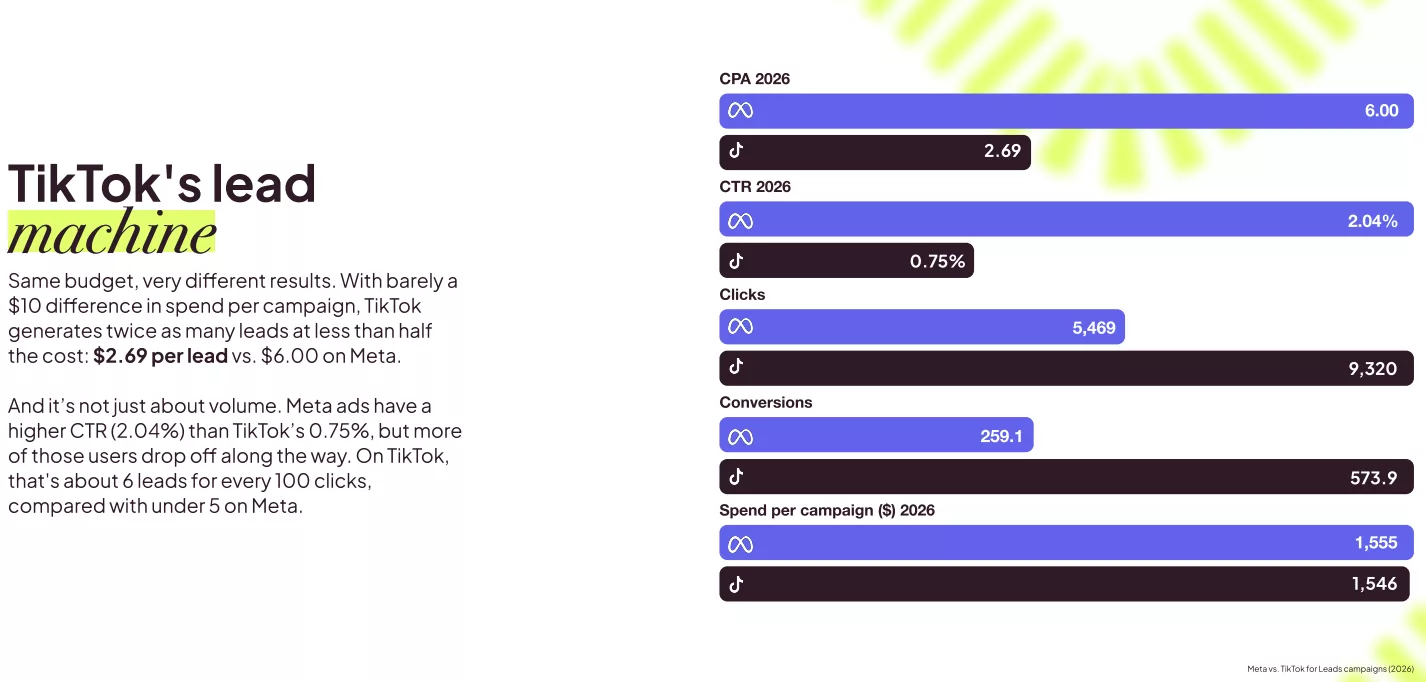
At the same time, Meta had a higher CTR – 2.04% compared with 0.75% on TikTok. This is a good example of why CTR should not be considered separately from final conversions.
Meta generates more clicks relative to impressions, but TikTok converted clicks into leads more effectively in this sample. For affiliate marketing, this is a crucial point. CTR is not the end result. If a cheaper click brings in lower-quality traffic, a low CPC quickly stops being an advantage.
Meta or TikTok in 2026?
The study does not offer a universal answer to which platform is “better.” And that may be the most sensible conclusion to draw from the numbers.
Meta remains the dominant platform in terms of advertiser numbers and has a huge amount of data from Sales campaigns. In Metricool’s sample, TikTok showed lower costs for reach, clicks, and leads, and its share of the budget among advertisers using both platforms is gradually increasing.
Meanwhile, Meta’s ROAS for Sales campaigns declined from 5.48x to 4.57x, against a backdrop of 47% growth in average campaign spending.
So the key takeaway for affiliate media buyers is not to simply shift budgets from Meta to TikTok. Rather, the data suggest comparing traffic sources at specific stages of the funnel and assessing the final economics.
- A low CPM does not necessarily mean a cheap click.
- A low CPC does not necessarily mean a cheap lead.
- A cheap lead does not necessarily mean a profitable sale.
And a high CTR – does not necessarily mean a high conversion rate.
Conclusion
In 2026, there is no definitive answer as to whether Meta or TikTok is better for affiliate marketing. Meta remains a strong platform, but its ads are becoming more expensive and ROAS is declining. TikTok, meanwhile, offers lower CPM, CPC, and cost per lead.
So instead of switching completely from one network to another, it is worth comparing them at specific stages of the funnel and looking at the final economics. After all, a cheap click or lead does not automatically translate into a profitable result.
What do you think of the study? Share your thoughts in our Telegram community, where we always discuss the latest trends in affiliate marketing and the broader marketing world!
Best regards, Your Geek!
Frequently Asked Questions
Not necessarily. The study does not provide a universal answer about which platform is better. It is worth comparing traffic sources by specific funnel stages and final economics.
In Metricool’s sample, TikTok had lower costs for reach, clicks, and leads. CPM was $0.38 versus $0.48 on Meta, and CPC was $0.03 versus $0.07.
No. A lower CPC does not necessarily mean a cheaper lead, and a cheaper lead does not necessarily mean a profitable deposit or sale. That is why the outcome after the click matters.