


Hello, community! Mobile apps have gradually turned into a tool that allows traffic to be monetized. At the same time, they are also a powerful source for generating leads. Especially when formats like In-App advertising exist.
Today, you can hear many opinions on whether this format is still alive. So we decided to explore this question a little, relying in particular on statistics. The result of our work is in today’s article.
Before we begin, let us remind you that we have already explained what In-App traffic is. We recommend checking it out!
How much is the In-App advertising market valued at?
To answer this question, we can turn to research from Grand View Research. They point to positive dynamics, emphasizing that the mobile app advertising market continues to grow steadily. This can be seen in the following chart:
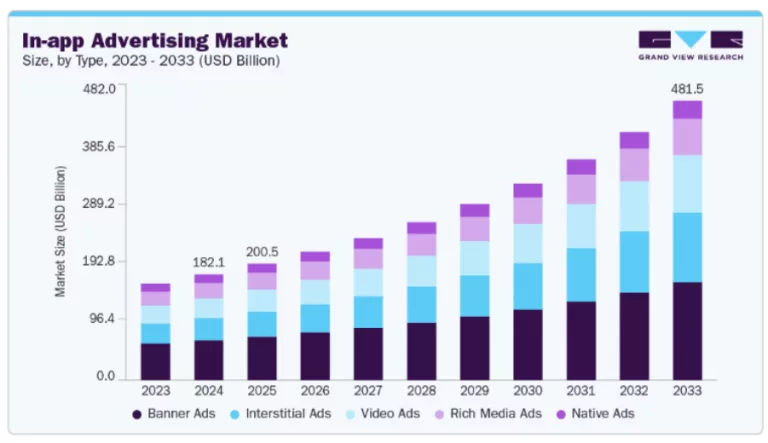
The market is currently valued at around $200.5 billion. By 2033, this figure is expected to reach $481.5 billion.
This shows that advertising inside apps is still in demand. And that demand will only continue to grow. So the question of whether the format is still relevant basically answers itself.
SocialPeta also found out how much advertising the market generates. Their report can be downloaded for free after filling out a contact information form.
Experts note that the number of ad creatives uploaded daily to the In-App advertising market exceeds 1+ million. The number of active advertisers in 2025 averages more than 84,000 per month and reaches around 90,000 at its peak. This is almost 22% more than in 2024.
So the market is definitely developing actively. And it is certainly not worth ignoring.
Prospects of the In-App advertising market
The format is alive — that is clear. Now it is worth looking at it from the perspective of future potential. After all, it is important that investments in advertising work not only here and now, but also in the future.
To understand the potential of In-App, we need to understand exactly what audience we are dealing with and how large it is. Exploding Topics helps us figure this out. They provide the following statistics:
- There are currently 5.28 billion smartphone users worldwide. They cite this statistic with reference to ElectroIQ research. In 2016, this number was much lower — around 3.67 billion active smartphone users were recorded at that time.
- Although the total number of smartphones is almost twice as high. This is only because some people have several devices at once.
- The number of smartphone users worldwide grew by at least 5% between 2020 and 2025.
- Smartphones account for more than 94% of all devices used to access the Internet.
- The TOP 3 countries in the world by the number of active smartphone users are China, India, and the United States.
The user profile is also changing. While men previously made up the majority of users, women have now started to outpace them by 1%.
The largest group of active users is people aged 18 to 29. They are followed by the 30 to 49 age group.
The audience is truly massive. But how many of these people actually use apps? After all, a smartphone can also be used simply for calls.
According to statistics from Bankmycell, users open an average of 9 to 10 apps daily. Accordingly, this is our potential traffic.
At the same time, almost half of all smartphone users open more than 11 different apps every day. These are mostly so-called “zoomers”.
As for users’ willingness to watch ads, Verve provides the answer here. They found that around 75% of users are willing to watch ads to receive additional benefits from using an app. For example, to connect to a VPN or receive an extra loot box in a game.
Why are people talking about the “death” of In-App advertising?
The answer is simple and quite ordinary — competition. Due to the high influx of advertisers into the industry, it is becoming increasingly difficult to get traffic. Advertising is getting more expensive, and with a small budget, it is no longer possible to achieve the same profit as a few years ago.
Of course, this is not a sign that the format no longer works. But it clearly shows that working with it has become somewhat more difficult. And most importantly — more expensive.
The highest competition is observed in gambling. The number of advertisers here has grown by 47% over the past year, while the number of creatives has increased by more than 22%. These statistics are shared by experts from Business of Apps with reference to SocialPeta.
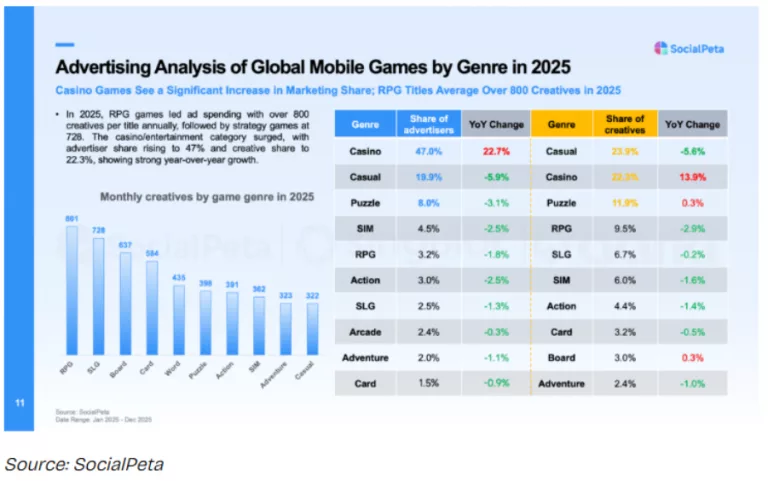
This is one of the reasons why installs are also becoming more expensive. Although this may be profitable for those driving traffic to these very installs. But if you are promoting your own apps, you should be prepared for downloads to become more expensive. Last year, the price increased by 12%, and it is quite possible that this year it will hit new records.
So yes, working with In-App is becoming more difficult. This is normal, because it is typical for formats that progress and become more popular. So you have to accept that the strongest survive — and become one of them. An alpha affiliate, so to speak.
Conclusion
So, to sum up, we can confidently say: In-App advertising is not just still relevant in 2026 — it continues to gain momentum and opens up more opportunities for advertisers. Market growth, a huge and active mobile audience, and users’ willingness to interact with ads create a strong foundation for the further development of this format.
In-App is no longer just an additional traffic source, but a full-fledged lead generation channel with strong potential. Those who start working with it now gain a significant long-term advantage. So ignoring this format means missing opportunities that are literally in every user’s pocket.
Do you buy advertising in mobile apps? Share your experience in our Telegram community, where we discuss current cases and fresh news from the world of affiliate marketing!
Sincerely, Your Geek!
Frequently Asked Questions
Yes, the format is not only still relevant, but also actively growing. The market is already valued at over $200 billion and continues to scale. Demand for advertising in apps is growing steadily, so the question of its relevance is basically no longer an issue.
There are more than 5.28 billion smartphone users worldwide, and most of them actively use apps every day. On average, people open 9–10 apps per day, while a significant share opens even more. This creates a huge and stable volume of traffic.
The main reason is growing competition. The number of advertisers and creatives is increasing rapidly, which makes traffic acquisition more difficult and raises advertising costs. At the same time, this does not mean the format is declining — it is simply becoming more demanding in terms of resources and strategy.